
Al-Farabi


| Philosopher and founder of political philosophy and logic in the Islamic world | |
|---|---|
 The Statue of al-Farabi at the Farabi International Award | |
| Full Name | Abu Nasr Muhammad b. Muhammad b. Tarkhan b. Awzalagh |
| Teknonym | The Second Teacher (al-Mu'allim al-Thani) |
| Birth | 259/872-73 or 260/873-74 |
| Place of Birth | Farab (Former Iran / present-day Kazakhstan) |
| Death | 339/950 |
| Burial Place | Damascus |
| Professors | Yuhanna b. Haylan, Abu Bishr Matta b. Yunus |
| Students | Abu Bakr b. Sarraj al-Nahwi, Yahya b. 'Adi al-Mantiqi, Ibrahim b. 'Adi |
| Works | Ihsa' al-'ulum, Ara' ahl al-madinat al-fadila, al-Siyasa al-madaniyya, Al-Madinat al-fadila, Al-Mantiqiyyat, Al-Tanbih 'ala sabil al-sa'ada, Kalam fi 'ilm al-ilahi |
Abū Naṣr Muḥammad b. Muḥammad b. Ṭarkhān (Arabic: أبونصر محمد بن محمد بن طَرخان) known as al-Fārābī (Arabic: الفارابي) (b. 259/872-73 or 260/873-74 – d. 339/950) was the founder of Islamic philosophy, the establisher of political philosophy and logic in the Islamic world, and known as the "Second Teacher" (al-Mu'allim al-Thani). He is considered the greatest Muslim philosopher and an authority in all branches of theoretical and practical wisdom such as theology, music, ethics, and politics.
The division of beings into Wajib al-Wujud (Necessary Being) and Mumkin al-Wujud (Contingent Being), the Argument from Contingency and Necessity, the unity of religion and philosophy, the Theory of Emanation regarding the creation of the world, and the Virtuous City (al-Madina al-Fadila) are among his views. Some researchers have also attributed the belief in Wilayat al-Faqih (Guardianship of the Jurist) to him.
Al-Farabi is said to have authored more than one hundred works, which have been translated into various languages. Some of his most important works include Ihsa' al-'ulum, Ara' ahl al-madinat al-fadila, al-Siyasa al-madaniyya, al-Madinat al-fadila, al-Musiqi al-kabir, al-Mantiqiyyat, al-Fusul al-muntaza'a, and Fusus al-hikam. Numerous books have been published regarding his biography and thoughts. Many scientific centers have been named after him, and media productions have been created about him.
Citing various evidence, including al-Farabi's statements about the characteristics of the head of society and the Imam and Imamate, a number of researchers have considered him to be Shi'a. Some have counted him as an Isma'ili Shi'a. Al-Farabi passed away in 339/950 at the age of eighty in Damascus; Sayf al-Dawla al-Hamdani, the then-ruler of al-Sham, performed the funeral prayer over him, and he was buried there.
Place and Importance
Abu Nasr al-Farabi has been considered the founder of Islamic philosophy,[1] the greatest Muslim philosopher,[2] the founder of political philosophy in Islam,[3] and the establisher[4] or father of Islamic logic.[5] He is counted among the prominent philosophers of Peripatetic philosophy.[6] He is also regarded as the first and most prominent Muslim thinker to have engaged in the philosophical study of music.[7]
It is said that al-Farabi was the first person to transfer formal logic completely and systematically from Greece to the Arab world.[8] Al-Farabi's thoughts are considered influential on subsequent philosophers, to the extent that it is said the roots of all ideas in Islamic philosophy trace back to al-Farabi.[9] According to some, al-Farabi is the first person to have compiled an encyclopedia; no one before him had gathered all the knowledge and sciences of their time.[10]
According to Seyyed Hossein Nasr, al-Farabi played a fundamental role in organizing sciences and creating harmony between them and Islamic teachings during the era of the translation of various sciences from different cultures, preventing disorder and chaos in the intellectual and rational life of Muslims. Nasr has called al-Farabi a model for contemporary Islamic thinkers in this regard.[11]
Al-Farabi has been given the title "The Second Teacher" (al-Mu'allim al-Thani) (the Second Teacher after Aristotle, who was the First Teacher).[12] Reasons cited for granting this title to al-Farabi include founding Islamic philosophy, establishing logic in the Islamic world, being the greatest philosopher after Aristotle, his efforts in the classification of sciences, and devising methodology in sciences.[13]
Al-Farabi's name is registered in the UNESCO list of global luminaries.[14] The year 2020-2021 was designated by UNESCO as the year to commemorate him, marking the 1150th anniversary of his birth.[15]
Biography
Information regarding al-Farabi's biography is considered scarce.[16] Abu Nasr Muhammad b. Muhammad b. Tarkhan b. Awzalagh, known as al-Farabi,[17] was born in 259/872-73[18] or 260/873-74[19] in the village of Wasij,[20] one of the villages of the city of Farab, a region of ancient Iran and present-day Kazakhstan.[21] In al-Fihrist by Ibn al-Nadim (written in 377/987), it is stated that he was from Faryab, one of the regions of Khorasan.[22]
During the time of al-Mu'tadid al-'Abbasi, the sixteenth Abbasid caliph (reign: 278/891 – 289/902), al-Farabi traveled with his father, who was a military man, to the city of Harran and from there to Baghdad, where he learned logic, philosophy, literature, mathematics, and basic sciences.[23] He traveled from Baghdad to Damascus and from there to Egypt, later returning to Damascus where he settled. This was during the rule of Sayf al-Dawla al-Hamdani (reign: 333/944 – 356/967) over al-Sham.[24]
Yuhanna b. Haylan (d. before 320/932) and Abu Bishr Matta b. Yunus (d. 328/940), both Christian philosophers, are mentioned as al-Farabi's most famous[25] teachers of logic and philosophy.[26] Abu Bakr b. Sarraj al-Nahwi is named as al-Farabi's teacher in grammar and his student in logic.[27] Abu Zakariyya Yahya b. 'Adi al-Mantiqi and his brother Ibrahim were also students of al-Farabi.[28] It is said that before turning to philosophy, al-Farabi was engaged in the profession of judgeship.[29]
According to Ibn Khallikan, a historian of the seventh/thirteenth century, al-Farabi was familiar with the Turkish language and some non-Arabic languages.[30] It is narrated from Ibn Khallikan in Wafayat al-a'yan that al-Farabi was familiar with seventy languages,[31] but this statement has been considered exaggerated.[32] Some have considered him to be of Turkish descent.[33] The Stanford Encyclopedia of Philosophy states that there is a difference of opinion regarding al-Farabi's origin; some have considered his origin to be Turkic, but new research has shown that he was Persian (Iranian).[34]

Citing various evidence, including al-Farabi's statements regarding the characteristics of the head of society and the Imam and Imamate, some researchers have considered him to be Shi'a.[35] It is also said that philosophers did not have good relations with Sunnism and most philosophers were inclined towards Shi'a.[36] Some have considered him an Isma'ili Shi'a.[37] Claims of consensus regarding al-Farabi being Shi'a have also been made.[38]
Al-Farabi passed away in Rajab[39] 339/950 at the age of eighty in Damascus.[40] Sayf al-Dawla al-Hamdani prayed over him, and he was buried in Damascus.[41]
Thoughts
Al-Farabi is described as a thinker who presented specific views in all branches of theoretical wisdom such as theology, mathematics, and music, and practical wisdom such as ethics and politics.[42] Some of his thoughts are as follows:
Relationship between Religion and Philosophy
Al-Farabi is considered a believer in the unity of religion and philosophy. According to him, human beings possess two faculties: the rational faculty and the imaginative faculty. The rational faculty relates to philosophy, and the imaginative faculty relates to religion. The philosopher reaches absolute truth through the rational faculty, and the prophet reaches it through the imaginative faculty. Although the methods of reaching the truth differ, the goal is the same.[43] It is said that al-Farabi's innovation in linking religion and philosophy lies in his method, which is through the description of the intellect and the faculties of the soul.[44] Al-Farabi believed that if religion follows true and certain philosophy, it is a correct religion, and if it follows speculative and non-true philosophy, it will be a corrupt religion.[45]
Division of Beings into Necessary and Contingent
The terminology of Necessary (Wajib) and Contingent (Mumkin) and the division of beings into Wajib al-Wujud and Mumkin al-Wujud are considered among his thoughts.[46] According to some researchers, the Argument from Contingency and Necessity is one of al-Farabi's innovations, borrowed from him by Ibn Sina in Islamic philosophy and Thomas Aquinas in Western philosophy.[47] It is said that al-Farabi referred to God with expressions such as "First Cause," "First Being," and "Necessary Being" (Wajib al-Wujud).[48]
Theory of Emanation and Hierarchy of Being
Regarding how the world was created, al-Farabi believed in the Theory of Emanation (Fayd). According to him, the world came into existence due to the emanation of God's existence, and the existence of the world is an inseparable necessity of God's existence.[49] Based on his view, the hierarchy of the system of existence is as follows: God, the World of Intellect (First to Ninth Intellects), the Active Intellect (Tenth Intellect), soul, form, matter, and bodies.[50] Al-Farabi believed in the Ten Intellects and considered them to be immaterial.[51] He applied the Ten Intellects to Angels and the Tenth Intellect to Ruh al-Amin and Ruh al-Qudus.[52]
God's Knowledge
It is said that al-Farabi is the first Muslim philosopher to have discussed the manner of God's prior knowledge of things.[53] In his book Fusul muntaza'a, al-Farabi denied God's knowledge of sensible particulars, believing that such a belief leads to adverse consequences such as the emergence of inconsistent beliefs among God's knowledge and God's knowledge becoming infinite.[54] However, it is said that he accepted Divine knowledge of particulars in his other books.[55]
Virtuous City
Al-Farabi is considered to be influenced by Plato in the design and organization of the Islamic Virtuous City (al-Madina al-Fadila).[56] He believed that human beings have no choice but to live socially to achieve the desired perfection, and all societies seek happiness; however, the society that seeks true happiness is called the Virtuous City.[57] Al-Farabi calls the people of such a city the Virtuous Nation (al-Umma al-Fadila).[58] In contrast to the Virtuous City, he proposed non-virtuous cities such as the Ignorant City (al-Madina al-Jahila), the Immoral City (al-Madina al-Fasiqa), and the Erring City (al-Madina al-Dalla).[59]
Al-Farabi considers the Virtuous City to have five pillars and classes: The Virtuous (philosophers and thinkers), The Orators (bearers and propagators of religion, speakers, and poets), The Estimators (mathematicians, geometers, physicians, and astronomers), The Warriors (guardians of society), and The Producers (farmers and merchants).[60]
Comparing the Virtuous City to a healthy body, he believes that just as the heart, as the most perfect organ of the body, is the ruler of the body, the ruler and first head of the society and the Virtuous City must also be the most perfect member of the society,[61] who is the same as the prophet or the philosopher.[62] In his view, all prophets were philosophers; prophets are called prophets regarding what is emanated from the Active Intellect to their imaginative faculty, and they are called philosophers regarding what is emanated from the Active Intellect to their passive intellect. Such a person is considered the most perfect and happiest human being.[63] It is said that al-Farabi combined his Islamic religious beliefs with the Greek philosophical tradition in the theory of the philosopher-prophet.[64]
Guardianship of the Jurist
In some of his works, al-Farabi has described the successors of the first ruler of the Virtuous City and their characteristics.[65] In the book al-Milla, he writes that whenever the first ruler and one of the Imams of the Righteous (A'imma al-Abrar) pass away and there is no one like them to succeed, the jurist succeeds them.[66] Some authors have applied this theory to the theory of Wilayat al-Faqih.[67]
Classification of Sciences
Al-Farabi classified the sciences common in his era[68] into eight categories: Linguistics, Logic, Mathematical Science (Ta'limi), Natural Science, Divine Science (Theology), Civil Science (Politics), Jurisprudence (Fiqh), and Theology (Kalam).[69]
Works

Al-Farabi is said to have authored more than one hundred works, many of which have been translated into various languages such as Persian, Turkish, English, German, French, and Hebrew.[70] According to Muhsin Mahdi, an al-Farabi scholar and professor at the University of Chicago and Harvard (originally from Iraq), most of the surviving works of al-Farabi can be categorized into two groups: logic and politics; although he also has works on music.[71] Some have classified his works under five titles: Logic; Astronomy, Mathematics, Music, and Natural Sciences; Metaphysics; Politics; and the Philosophy of Plato and Aristotle.[72]
Some of al-Farabi's most important works include: Ihsa' al-'ulum, Ara' ahl al-madinat al-fadila, al-Siyasa al-madaniyya, al-Musiqi al-kabir, al-Mantiqiyyat, al-Tanbih 'ala sabil al-sa'ada, Kalam fi 'ilm al-ilahi, al-Fusul al-muntaza'a, Fusus al-hikam, and al-Jam' bayn ra'yay al-hakimayn Aflatun al-ilahi wa Aristatalis.[73] The book Ihsa' al-'ulum, which deals with the classification of sciences,[74] is considered to be widely renowned and influential in the West and the East.[75] This book has been translated into various languages such as Hebrew and Latin.[76]
The collection of al-Farabi's works, along with books related to him, has been compiled in the software "Majmu'a-yi athar-i Hakim Farabi" (Collection of Works of Sage Farabi) by the Computer Research Center of Islamic Sciences (Noor).[77]
Works about Farabi
Numerous books and works have been produced and published regarding the biography and thoughts of al-Farabi. Also, some scientific centers and institutions have been named in memory of al-Farabi, such as Al-Farabi Kazakh National University,[78] the Farabi International Award,[79] the College of Farabi at the University of Tehran,[80] Al-Farabi University College in Baghdad,[81] Farabi University of Science and Technology affiliated with the Army of the Islamic Republic of Iran,[82] and Farabi Eye Hospital in Tehran.[83]
A documentary titled "The Light of Civilization" about al-Farabi has been produced on the national television of Kazakhstan.[84] Also, the Farabi House-Museum, dedicated to the various stages of his life and the introduction of al-Farabi's intellectual heritage, was inaugurated in Istanbul, Turkey, in 2019.[85] According to the report of the Islamic Culture and Relations Organization's news agency, the state prize of the Republic of Kazakhstan in the field of science and technology is named after al-Farabi, and al-Farabi's image has been printed on the first currency unit of Kazakhstan (Tenge).[86]
Bibliography
Some of the books written about al-Farabi include:
- Al-Farabi, Founder of Islamic Neoplatonism: His Life, Works and Influence, by Majid Fakhri. In this book, Fakhri discusses al-Farabi's logical, political, metaphysical, and musical views, the influence of his thoughts on Muslim and Western philosophers, and his role as a connecting link between Greek philosophy and Islamic philosophy.
- Farabi mu'assis-i falsafa-yi Islami (Farabi, the Founder of Islamic Philosophy), in perisan, by Rida Dawari Ardakani, Tehran, Institute for Humanities and Cultural Studies.
- Abu Nasr Farabi filsuf-i farhang (Abu Nasr Farabi, the Philosopher of Culture) (Collection of speeches on knowledge, rereading the thoughts and works of Farabi), in persian language, by Ghulamhusayn Ibrahimi Dinani and Ismail Mansuri Larijani, Tehran, Soroush Publications, first edition, 1403 Sh/2024.
- Abu Nasr al-Farabi fi l-dhikra l-alfiyya li-wafatih (Abu Nasr al-Farabi on the Millennial Anniversary of his Death), by Ibrahim Bayyumi Madkur, Cairo, Al-Hay'a al-Misriyya al-'Amma li-l-Kitab, 1403 AH/1983.
Global Congress of al-Farabi
In March 2023, the first global congress on "Farabi and Islamic Culture and Civilization" was held in Tehran with the aim of honoring al-Farabi's status, organized by the Institute for Cultural and Social Studies and the Permanent Secretariat of the Farabi International Award.[87] The collection of articles from this conference has been published in a book titled "Farabi and His Thoughts".[88] Several international conferences titled and related to al-Farabi have also been held in Kazakhstan.[89]
-
 Poster of the first Global Congress of Farabi.
 -
 Commemorative stamp for the millennium of al-Farabi's death, 1950.
 -
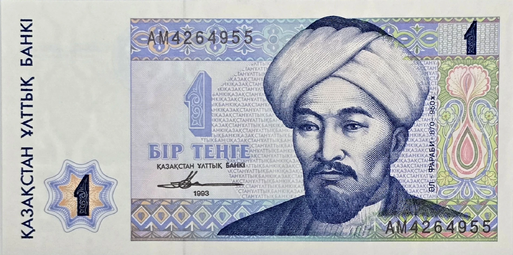 Image of al-Farabi on the one Tenge banknote of Kazakhstan.
 -
 Statue of al-Farabi on the campus of al-Farabi Kazakh National University.


Notes
- ↑ Naʿma, Falāsifat al-Shīʿa, p. 567; Mahdi, Al-Fārābī wa taʾsīs al-falsafa al-Islāmiyya, 2009, p. 76.
- ↑ Ibn Khallikān, Wafayāt al-aʿyān, vol. 5, p. 153; Naʿma, Falāsifat al-Shīʿa, 1987, p. 567.
- ↑ Mahdi, Fārābī wa bunyāngudhārī-yi falsafa-yi siyāsī-yi Islāmī, 1400 Sh, pp. 13, 24, 66.
- ↑ Yūsufiyān, «Shakl-gīrī-yi falsafa-yi Islāmī», p. 207.
- ↑ Yūsufiyān, «Shakl-gīrī-yi falsafa-yi Islāmī», p. 213.
- ↑ Naʿma, Falāsifat al-Shīʿa, pp. 576-579.
- ↑ See: "Fārābī; buzurgtarīn naẓarīya-pardāz-i mūsīqī dar tārīkh-i Islām", IRNA; "Fārābī; buzurgtarīn naẓarīya-pardāz-i mūsīqī dar tārīkh-i Islām", Dinonline.
- ↑ Naʿma, Falāsifat al-Shīʿa, 1987, p. 568.
- ↑ Naʿma, Falāsifat al-Shīʿa, 1987, p. 569.
- ↑ Ṭūqān, Al-Khālidūn al-ʿArab, 1954, p. 85.
- ↑ Naṣr, Sunnat-i ʿaqlānī-yi Islām dar Īrān, 1383 Sh, p. 125.
- ↑ Shahrzūrī, Tārīkh al-ḥukamāʾ, 2007, p. 300; Naʿma, Falāsifat al-Shīʿa, 1987, p. 567; Naṣr, Sunnat-i ʿaqlānī-yi Islāmī dar Īrān, 1383 Sh, p. 121.
- ↑ Naṣr, Sunnat-i ʿaqlānī-yi Islāmī dar Īrān, 1383 Sh, pp. 122-124; Yūsufiyān, «Shakl-gīrī-yi falsafa-yi Islāmī», p. 207.
- ↑ See: "Asāmī-yi 33 nām-āvar wa mashāhīr-i Īrānī bi sabt-i UNESCO rasīda ast", Website of the Great Islamic Encyclopedia Centre; "Asāmī-yi 33 nām-āvar wa mashāhīr-i Īrānī bi sabt-i UNESCO rasīda ast", IRNA.
- ↑ "Wazīr-i farhang: Fārābī bi qulla-ī bā shukūh dar tamaddun-i Islāmī tabdīl shuda ast", IRNA.
- ↑ Mahdi, Fārābī wa bunyāngudhārī-yi falsafa-yi siyāsī-yi Islāmī, 1400 Sh, p. 25; Dāwarī Ardakānī, Fārābī muʾassis-i falsafa-yi Islāmī, 1377 Sh, pp. 65-66; Yūsufiyān, «Shakl-gīrī-yi falsafa-yi Islāmī», p. 203.
- ↑ Ibn Khallikān, Wafayāt al-aʿyān, vol. 5, p. 153.
- ↑ Ibrāhīmī Dīnānī & Manṣūrī Lārījānī, Abū Naṣr Fārābī, 1403 Sh, p. 13; Naʿma, Falāsifat al-Shīʿa, 1987, p. 567.
- ↑ Maḥfūẓ, Muʾallafāt al-Fārābī, 1395 AH, p. 23.
- ↑ Maḥfūẓ & Āl Yāsīn, Muʾallafāt al-Fārābī, 1395 AH, p. 23; Dāwarī Ardakānī, Fārābī muʾassis-i falsafa-yi Islāmī, 1377 Sh, p. 66.
- ↑ Ibrāhīmī Dīnānī & Manṣūrī Lārījānī, Abū Naṣr Fārābī, 1403 Sh, pp. 7, 13.
- ↑ Ibn Nadīm, Al-Fihrist, p. 368.
- ↑ Ibrāhīmī Dīnānī & Manṣūrī Lārījānī, Abū Naṣr Fārābī, 1403 Sh, pp. 7, 13.
- ↑ Ibn Khallikān, Wafayāt al-aʿyān, vol. 5, p. 155.
- ↑ Yūsufiyān, «Shakl-gīrī-yi falsafa-yi Islāmī», pp. 206-207.
- ↑ Ibn Khallikān, Wafayāt al-aʿyān, vol. 5, pp. 153-154.
- ↑ Yūsufiyān, «Shakl-gīrī-yi falsafa-yi Islāmī», p. 207.
- ↑ Yūsufiyān, «Shakl-gīrī-yi falsafa-yi Islāmī», p. 207.
- ↑ Yūsufiyān, «Shakl-gīrī-yi falsafa-yi Islāmī», p. 203.
- ↑ Ibn Khallikān, Wafayāt al-aʿyān, vol. 5, p. 153.
- ↑ Ibn Khallikān, Wafayāt al-aʿyān, vol. 5, p. 155.
- ↑ Yūsufiyān, «Shakl-gīrī-yi falsafa-yi Islāmī», p. 204.
- ↑ Ibn Khallikān, Wafayāt al-aʿyān, vol. 5, p. 153; Yūsufiyān, «Shakl-gīrī-yi falsafa-yi Islāmī», p. 203.
- ↑ "al-Farabi", Stanford Encyclopedia of Philosophy.
- ↑ Naʿma, Falāsifat al-Shīʿa, 1987, pp. 576-579; Dāwarī Ardakānī, Fārābī muʾassis-i falsafa-yi Islāmī, 1377 Sh, pp. 66-67.
- ↑ Dāwarī Ardakānī, Fārābī muʾassis-i falsafa-yi Islāmī, 1377 Sh, pp. 66-67.
- ↑ Yūsufiyān, «Shakl-gīrī-yi falsafa-yi Islāmī», p. 238.
- ↑ Ḥusaynī, Falsafa-yi siyāsī-yi Fārābī wa irtibāṭ-i ān bā wilāyat-i faqīh, 1389 Sh, p. 36.
- ↑ Maḥfūẓ & Āl Yāsīn, Muʾallafāt al-Fārābī, 1395 AH, p. 24.
- ↑ Ibn Khallikān, Wafayāt al-aʿyān, vol. 5, p. 156; Naʿma, Falāsifat al-Shīʿa, 1987, p. 567; Dāwarī Ardakānī, Fārābī muʾassis-i falsafa-yi Islāmī, 1377 Sh, p. 67.
- ↑ Ibn Khallikān, Wafayāt al-aʿyān, vol. 5, p. 156.
- ↑ See: "Andīsha-yi Fārābī pāsukh-gū-yi masāʾil-i fikrī wa farhangī-yi imrūz-i bashar ast", News website of Al-Mustafa International University.
- ↑ Muqarrabī & Pūr-Ḥasan, «Nū-āvarī-yi Fārābī dar bāb-i rābiṭa-yi dīn wa falsafa...», pp. 12-13.
- ↑ Muqarrabī & Pūr-Ḥasan, «Nū-āvarī-yi Fārābī dar bāb-i rābiṭa-yi dīn wa falsafa...», p. 13.
- ↑ Fārābī, Al-Ḥurūf, 1970, pp. 153-154.
- ↑ Naʿma, Falāsifat al-Shīʿa, 1987, p. 568.
- ↑ Badawī, Mawsūʿat al-falsafa, 1429 AH, vol. 2, p. 102; Ḥusayn-Zāda, Falsafa-yi dīn, 1375 Sh, p. 101.
- ↑ Yūsufiyān, «Shakl-gīrī-yi falsafa-yi Islāmī», p. 217.
- ↑ Fārābī, Al-Siyāsa al-madaniyya, 1996, p. 45.
- ↑ Fārābī, Al-Siyāsa al-madaniyya, 1996, pp. 21-28.
- ↑ Fārābī, Al-Siyāsa al-madaniyya, 1996, p. 21.
- ↑ Fārābī, Al-Siyāsa al-madaniyya, 1996, pp. 22-23.
- ↑ Ḥājīhā et al., «ʿIlm-i pīshīn-i Ilāhī az dīdgāh-i ḥikmat-i Ṣadrāyī...», p. 49.
- ↑ Fārābī, Fuṣūl muntazaʿa, 1405 AH, p. 90.
- ↑ Yūsufiyān, «Shakl-gīrī-yi falsafa-yi Islāmī», p. 220.
- ↑ Yūsufiyān, «Shakl-gīrī-yi falsafa-yi Islāmī», p. 232.
- ↑ Fārābī, Ārāʾ ahl al-madīnat al-fāḍila, 1995, pp. 112-113.
- ↑ Fārābī, Ārāʾ ahl al-madīnat al-fāḍila, 1995, p. 113; Fārābī, Al-Siyāsa al-madaniyya, 1996, p. 89.
- ↑ Fārābī, Ārāʾ ahl al-madīnat al-fāḍila, 1995, p. 128; Fārābī, Al-Siyāsa al-madaniyya, 1996, p. 99.
- ↑ Fārābī, Fuṣūl muntazaʿa, 1405 AH, pp. 65-66.
- ↑ Fārābī, Ārāʾ ahl al-madīnat al-fāḍila, 1995, pp. 114, 116.
- ↑ Fārābī, Ārāʾ ahl al-madīnat al-fāḍila, 1995, pp. 121-122.
- ↑ Fārābī, Ārāʾ ahl al-madīnat al-fāḍila, 1995, p. 121.
- ↑ Yūsufiyān, «Shakl-gīrī-yi falsafa-yi Islāmī», p. 232.
- ↑ See: Fārābī, Ārāʾ ahl al-madīnat al-fāḍila, 1995, p. 124; Fārābī, Al-Milla wa nuṣūṣ ukhar, 1991, p. 50.
- ↑ See: Fārābī, Al-Milla wa nuṣūṣ ukhar, 1991, p. 50.
- ↑ See: Ḥusaynī, Falsafa-yi siyāsī-yi Fārābī wa irtibāṭ-i ān bā wilāyat-i faqīh, 1389 Sh, pp. 295-298, 307.
- ↑ Fārābī, Iḥṣāʾ al-ʿulūm, 1996, pp. 5, 15.
- ↑ See: Fārābī, Iḥṣāʾ al-ʿulūm, 1996, pp. 15-16, 17-79.
- ↑ Maḥfūẓ & Āl Yāsīn, Muʾallafāt al-Fārābī, 1395 AH, p. 24.
- ↑ Mahdi, Fārābī wa bunyāngudhārī-yi falsafa-yi siyāsī-yi Islāmī, 1400 Sh, p. 106.
- ↑ "Fārābī yā Muʿallim-i Thānī; fīlsūfī ki dīn rā mawḍūʿ-i muṭālaʿa qarār dād", The Centre for the Great Islamic Encyclopaedia.
- ↑ Maḥfūẓ & Āl Yāsīn, Muʾallafāt al-Fārābī, 1395 AH, pp. 25-30; Yūsufiyān, «Shakl-gīrī-yi falsafa-yi Islāmī», p. 208.
- ↑ Yūsufiyān, «Shakl-gīrī-yi falsafa-yi Islāmī», p. 208.
- ↑ Naṣr, Sunnat-i ʿaqlānī-yi Islāmī dar Īrān, 1383 Sh, p. 124.
- ↑ Mahdi, Fārābī wa bunyāngudhārī-yi falsafa-yi siyāsī-yi Islāmī, 1400 Sh, p. 32.
- ↑ "Majmūʿa-yi āthār-i Ḥakīm Fārābī raḥima-hu Allāh", Website of Computer Research Center of Islamic Sciences.
- ↑ "al-Farabi Kazakh National University", Farabi University.
- ↑ "Muʿarrifī", Website of Farabi International Award.
- ↑ "Pīshīna-yi Dānishkadagān-i Fārābī-yi Dānishgāh-i Tehrān", Website of College of Farabi.
- ↑ "Ḥawl al-Jāmiʿa", Website of Al-Farabi University College.
- ↑ "Sabt-i nām-i Dānishgāh-i Afsarī-yi Fārābī", Website of Moshaver Group.
- ↑ "Muʿarrifī-yi Bīmāristān-i Fārābī", Website of Farabi Hospital.
- ↑ "Fārābī, taʾthīr-i ū dar Qazāqistān wa āthār-i ū dar Īrān", Website of Islamic Culture and Relations Organization.
- ↑ "Khāna-Mūza-yi Fārābī dar Turkiya!", ISNA.
- ↑ "Fārābī, taʾthīr-i ū dar Qazāqistān wa āthār-i ū dar Īrān", Website of Islamic Culture and Relations Organization.
- ↑ "Guzārish-i nahāyī-yi nukhustīn kungira-yi jahānī-yi Fārābī...", Website of Farabi International Award.
- ↑ "Fārābī wa andīshahā-yi ū: majmūʿa maqālāt-i nukhustīn kungira-yi jahānī-yi Fārābī...", Institute for Cultural and Social Studies.
- ↑ "Chahārumīn hamāyish-i bayn al-milalī-yi Fārābī dar Qazāqistān barguzār shud", Islamic Culture and Relations Organization.
References
- Badawī, ʿAbd al-Raḥmān. Mawsūʿat al-falsafa. Qom, Dhawī l-Qurbā, 1429 AH.
- Dāwarī Ardakānī, Riḍā. Fārābī muʾassis-i falsafa-yi Islāmī. Tehran, Pazhūhishgāh-i ʿUlūm-i Insānī wa Muṭālaʿāt-i Farhangī, 1377 Sh.
- Fārābī, Muḥammad b. Muḥammad al-. Al-Ḥurūf. Researched by Muḥsin Mahdī. Beirut, Dār al-Mashriq, 1970.
- Fārābī, Muḥammad b. Muḥammad al-. Al-Milla wa nuṣūṣ ukhar. Researched by Muḥsin Mahdī. Beirut, Dār al-Mashriq, 2nd ed., 1991.
- Fārābī, Muḥammad b. Muḥammad al-. Al-Siyāsa al-madaniyya. Beirut, Dār wa Maktabat al-Hilāl, 1st ed., 1996.
- Fārābī, Muḥammad b. Muḥammad al-. Ārāʾ ahl al-madīnat al-fāḍila. Beirut, Dār wa Maktabat al-Hilāl, 1995.
- Fārābī, Muḥammad b. Muḥammad al-. Fuṣūl muntazaʿa. Tehran, Maktabat al-Zahrāʾ, 1405 AH.
- Fārābī, Muḥammad b. Muḥammad al-. Iḥṣāʾ al-ʿulūm. Beirut, Dār wa Maktabat al-Hilāl, 1996.
- Ḥājīhā, ʿAbbās et al. "ʿIlm-i pīshīn-i Ilāhī az dīdgāh-i ḥikmat-i Ṣadrāyī wa Sīnavī wa taṭbīq-i ān bā āyāt wa riwāyāt". Dūfaṣlnāma-yi Ḥikmat-i Ṣadrāyī. No. 12, Khurdād 1397 Sh.
- Ḥusaynī, Muḥammad Ḥusayn. Falsafa-yi siyāsī-yi Fārābī wa irtibāṭ-i ān bā wilāyat-i faqīh. Qom, Markaz-i Bayn al-Milalī-yi Tarjuma wa Nashr-i Al-Muṣṭafā (s), 1st ed., 1389 Sh.
- Ḥusayn-Zāda, Muḥammad. Falsafa-yi dīn; barrasi-yi taṭbīqī-yi barāhīn-i ithbāt-i Khudā. Tehran, Sāzmān-i Tablīghāt-i Islāmī, 1375 Sh.
- Ibn Khallikān, Aḥmad b. Muḥammad. Wafayāt al-aʿyān wa anbāʾ abnāʾ al-zamān. Beirut, Dār al-Fikr, n.d.
- Ibn Nadīm, Muḥammad b. Isḥāq. Al-Fihrist. Beirut, Dār al-Maʿrifa, n.d.
- Ibrāhīmī Dīnānī, Ghulām Ḥusayn & Ismāʿīl Manṣūrī Lārījānī. Abū Naṣr Fārābī; fīlsūf-i farhang; majmūʿa guftārhā-yi maʿrifat bāzkhānī-yi andīsha wa āthār-i Fārābī. Tehran, Surūsh, 1403 Sh.
- Maḥfūẓ, Ḥusayn ʿAlī & Jaʿfar Āl Yāsīn. Muʾallafāt al-Fārābī. Baghdad, Maṭbaʿat al-Adīb al-Baghdādīyya, 1395 AH.
- Mahdī, Muḥsin. Al-Fārābī wa taʾsīs al-falsafa al-Islāmiyya. Beirut, Dār al-Fārābī, 2009.
- Mahdī, Muḥsin. Fārābī wa bunyāngudhārī-yi falsafa-yi siyāsī-yi Islāmī. Translated by Muḥammad Iḥsān Muṣḥafī. Tehran, Intishārāt-i Ḥikmat, 1st ed., 1400 Sh.
- Muqarrabī, Nawwāb & Qāsim Pūr-Ḥasan. "Nū-āvarī-yi Fārābī dar bāb-i rābiṭa-yi dīn wa falsafa naẓarīya-yi silsila marātibī-yi zabān-i dīn". Faṣlnāma-yi Tārīkh-i Falsafa. No. 9, Summer 1391 Sh.
- Naʿma, ʿAbd Allāh. Falāsifat al-Shīʿa; ḥayātuhum wa ārāʾuhum. Qom, Dār al-Kitāb al-Islāmī, 1987.
- Naṣr, Sayyid Ḥusayn. Sunnat-i ʿaqlānī-yi Islāmī dar Īrān. Translated by Saʿīd Diḥqān. Tehran, Qaṣīda-sarā, 1st ed., 1383 Sh.
- Shahrzūrī, Muḥammad b. Maḥmūd. Tārīkh al-ḥukamāʾ qabl ẓuhūr al-Islām wa baʿdah. Paris, Dār Bibliyon, 2007.
- Ṭūqān, Qadrī Ḥāfiẓ. Al-Khālidūn al-ʿArab. Beirut, Dār al-ʿIlm li-l-Malāyīn, 1954.
- Yūsufiyān, Ḥasan. "Shakl-gīrī-yi falsafa-yi Islāmī". In Darāmadī bar tārīkh-i falsafa-yi Islāmī. Vol. 1. Tehran, Intishārāt-i Samt; Qom, Muʾassisa-yi Āmūzishī wa Pazhūhishī-yi Imām Khumaynī, 1st ed., 1390 Sh.